


Focus point - The education system.
The freedom of parents to start their own school that fits their own beliefs and upbringing is firmly anchored in our constitution. As a result, the Netherlands has traditionally had a varied offer of schools so parents can choose a school that suits them and their children. If that school does not exist, parents can under conditions take the initiative to start a school. Traditionally, parents were often directly involved in the management of the school, among others through school associations.
Scale increase
In recent decades, education has seen strong scale increase and professionalization. The policy was mainly aimed at improving efficiency by increasing the quality of management. Due to this scale increase, the competent authority is now often formed by a professional foundation board with several schools, sometimes up to 75. The size of all types of schools is growing. The school is also more often part of a larger school organization. According to DUO (2018/2019), there are 977 school governing bodies and 6773 schools in primary education, so on average 6.9 schools per governing body. In secondary education, there were 330 governing bodies for 1454 school locations in 2018. These governing bodies have their own office organizations and are often professionally organized.
The position of parents has weakened with the scale increase. They no longer form part of the management. They are more and more seen and treated as consumers, sometimes as difficult, demanding customers. The school as a community where teachers, students, and parents work together on good education is under threat. Relationships can harden when people no longer know each other and institutional interests dominate. Parents do not know the people who are ultimately responsible for their child’s education. It is therefore time to strengthen the position of parents, but also of students and teachers, and to reduce the distance between the class and management.
This can only be done by placing control over education at the school. With smaller scale education where people know each other, the child is central, the parent is taken seriously, the teacher is appreciated and the school management serves what happens in the classroom. To do this, we must focus less on top-down educational innovation and more on continuous improvement at the class and school level. Freedom of education is a great good, provided it goes hand in hand with visible quality, evidence-informed education, and a sober and small-scale school culture where children have the highest priority.
Performance pressure
Parents often worry about performance pressure on their children. From a young age, children are tested and everything is recorded through student monitoring systems. We select early, making the school advice very important for the further school career. Especially since secondary education selects more strictly and makes it harder to move to other levels. The focus on pass rates, judging schools on dropouts and repeating years causes schools to unintentionally avoid giving children the benefit of the doubt. While schools should be aimed at getting the best out of children, at any level. Strict selection criteria in further education also cause high pressure on pupils. Parents want their children to have optimal chances and therefore increasingly invest in final test and exam training and private homework help. All this puts children under pressure while actual school results decline.
Our positions:
- Ensure that small scale is preserved in education and returns where it has disappeared. Set limits on the maximum size of schools, classes, and the number of schools under one school governing body.
- Reducing test and performance pressure must be a priority while we also strive for a strong increase in learning outcomes. This means schools must have a clear vision on how their teaching and pedagogical approach leads to good results without unnecessary focus on testing.
- Research must be done into whether the use of student monitoring systems and the possibility for parents and students to look in them negatively affects the perceived performance pressure.
- Give children chances by fighting early selection through prescribing broad first-year classes and reducing pressure on group 8 advice. Make moving to different levels as smooth as possible.
- Make agreements with schools and teacher training about improving the quality of language and math education and encourage the use of scientifically proven teaching methods.
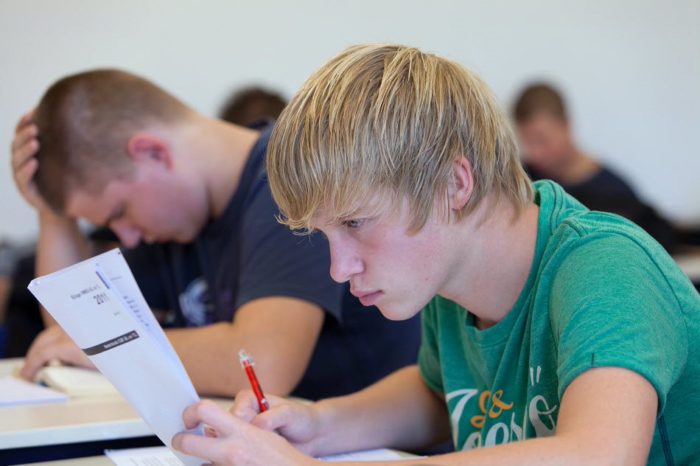
'Er moet een drempel opgeworpen worden voor leerlingen die willen doorstromen van havo naar vwo.'
Related Subjects
School governing body
Ouders & Onderwijs is er voor alle ouders met kinderen in de schoolgaande leeftijd. Ouders kunnen bij ons terecht voor advies en antwoorden op hun vragen.
Read moreTests and results
Ouders & Onderwijs is er voor alle ouders met kinderen in de schoolgaande leeftijd. Ouders kunnen bij ons terecht voor advies en antwoorden op hun vragen.
Read moreStudent monitoring system
A student monitoring system tracks your child's development at school. What is a student monitoring system?
Read moreSwitching to another school type
Is your child doing very well or very badly in secondary school? Then the school can advise switching to another school type.
Read more