



Don’t think: ‘Help, here comes another one!’.
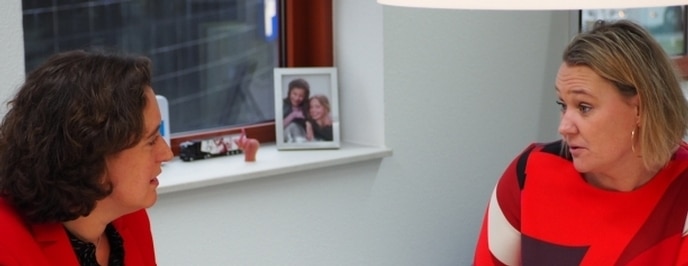
Good cooperation between parents and school promotes the development, well-being, and school success of children. How do you shape parental involvement in a positive way? A double interview with Rinda den Besten, chair of the PO-Raad and Lobke Vlaming, director of Ouders & Onderwijs in the context of the campaign ‘Together we are school’.
‘The voice of parents in education can and must be heard much more’, says the Ouders & Onderwijs website. At the same time, teachers sometimes struggle with parents who ‘take their seat’. Where do you think the line is for healthy involvement?
Lobke: ‘Parents want the best for their child, so they will always stand up for their interest. In my opinion, there is no strict line where parents may or may not interfere. It is more about schools having an open attitude towards parents and setting clear agreements with them. And parents must of course respect those agreements.’
Rinda: ‘The line is different for every teacher. One does not mind texting parents, another prefers email or only communicates face-to-face. It can be hard for parents that this is not fixed, but it does not have to be a problem. As a teacher, you must be clear from the start of the school year where your line is and how you do communicate with parents.’
How can schools shape parental involvement in a positive way?
Lobke: ‘Let parents think along on themes they are passionate about. For some, it is solar panels and for others cooking or reading aloud. I think parent evenings are generally more useful when the school not only sends information but also gives plenty of room for parents to contribute. This often works better in small groups.’
So it is okay if some parents stay at home?
Rinda: ‘That depends on the goal. For thematic parent evenings, it is indeed okay.’
Lobke: ‘At some times, you can expect parents to come, for example, at the start of the school year and when preparing for the transition to secondary education.’
Rinda: ‘Yes, that transition needs a lot of explanation, I know from personal experience. How does the school advice and the final test work exactly? What are the procedures around lottery? Much frustration comes from not understanding the systems.’
And if the school advice for your child is disappointing…?
Rinda: ‘As a teacher, you should always have a no-surprises basis. Do not start the conversation only when there is bad news but also talk in between. Stay professional, take responsibility, and sometimes show your authority. Show that you know what you are talking about.’
Lobke: ‘On the other hand, many parents who contact us are in panic. Their child is not doing well, so they feel stressed. No matter how well and professional the teacher tries to explain, it does not always come across well. Sometimes a conflict can be prevented if the teacher also shows emotional involvement and invests in the relationship with parents.’
Are these questions and conflicts often about tailored education?
Lobke: ‘Indeed, there is still a lot of uncertainty among parents about tailored education. This is partly because it is organized differently everywhere. It is often about barriers, finances, different desks. Parents get frustrated when responsibility is passed from one to another.’
Rinda: ‘We have made it too complicated in the Netherlands. The system is barely understandable for highly educated people. What I find important is that the school never withdraws from a child or hides behind a partnership tailored education. Partnership Tailored Education Noord-Kennemerland is a good example. There, school, youth care, and the partnership tailored education always first provide a suitable solution for the student. The financial aspect and paperwork follow afterwards. They always find a solution!’
How has the position of parents relative to the school changed over the decades?
Rinda: ‘I heard a youth doctor once say: ‘People nowadays have too few children.’ Meaning the average 1.2 child has become a kind of project with automatically a lot of pressure. Another thing is happening. For the first time, a generation of children is growing up that is worse off than their parents on average. I have not researched this, but I feel we now more quickly blame outside factors when a child’s development does not fit our perfect picture. An example: almost every parent has a discussion at some point in raising their child about reading versus computer use. Most parents regularly lose this fight. Me too. And who do we blame when children’s reading levels drop? Exactly, the school.’
Lobke: ‘Still, I think this time has brought a lot of good. Parents are much better informed than before and ask critical questions. Schools should use this to their advantage!’
How about the participation of parents? Is it more professional now than before?
Lobke: ‘In theory, yes. The school participation council has many rights and is often seen as a way to secure policy. I think it is good that the school participation council consists of both parents and teachers. But in many places, it can still be much more professional. One course is not enough. How do you really know what is going on? How do you read a budget? That asks a lot of parents.’
Finally, how can national organizations like the PO-Raad and Ouders & Onderwijs encourage positive parental involvement?
Rinda: ‘At the PO-Raad, we try to encourage schools and their governing bodies to take broad responsibility for education at the schools. We call it the horizontal dialogue. Not only does the government have the right to know how its money is spent, parents also have the right to information. We help schools with this, for example with the website Schools on the map.
Another important task for us is to tackle difficult issues, fight together or have the discussion. For example, with our members, we recently drafted a new guideline about voluntary parent contributions. We agreed that no student may be excluded from any activity, regardless of whether their parents pay the contribution. That goes beyond what the law requires.’
Lobke: ‘For Ouders & Onderwijs, the main task is to help parents communicate well with school. Also, I think we as organizations have a role model function in how we talk about each other. It is a matter of mindset. If a teacher already thinks: ‘Help, here comes that nagging parent again,’ that will not help, of course.
Rinda: ‘… or: ‘those teachers with all their holidays’…’
Lobke: ‘Exactly. We have a shared interest. We should say that more often. That is why the campaign ‘Together we are school’.

Sign up for our bi-weekly newsletter!
Receive the latest news, tips and experiences.