



Parents: large classes are not good for children.
Parents worry about the quality of education, safety and the atmosphere in large classes, according to the annual report the Staat van de Ouder 2025. In classes with more than 26 students, parents’ trust in quality and safety at school drops sharply. Parents with children in a large class also see that their children enjoy school less than children in smaller classes.
Classes that are too large are bad for education quality
Parents worry about the quality of education in large classes. The research shows that in classes with 16 to 20 students, 63% of parents are (very) satisfied with the quality of education. In larger classes, the number of satisfied parents drops sharply. When a class has more than 30 children, only 45% of parents are satisfied with the education quality.
Safety and enjoyment are also under pressure from large classes
Large classes affect education quality, but children also enjoy school less and feel less safe. In classes larger than 30 children, 47% of parents see that their child feels less safe at school. In classes between 16 and 25 children, this is 65% of parents. Parents with children in large classes also less often say that their child enjoys going to school.
When do parents find a class too large?
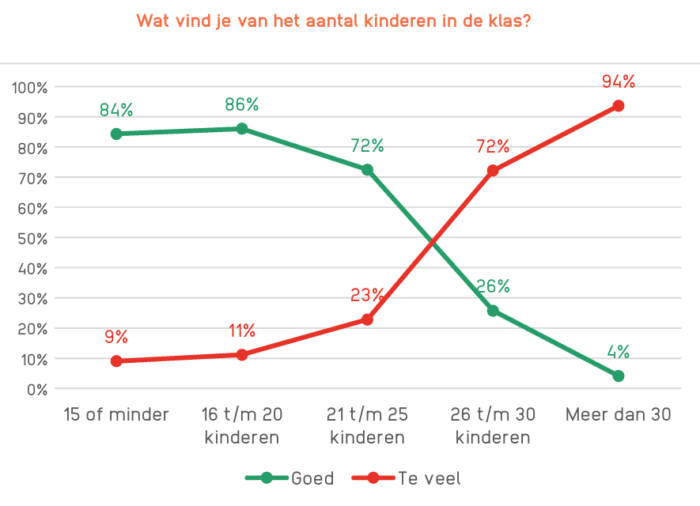
Parents find a class with more than 25 children too large. In a class of 21 to 25 children, only 23% of parents find their child’s class too large. In a class of 25 to 30 children, a clear majority of 72%. A class with more than 30 children is found too large by 94% of parents.
Teacher shortage causes unrest among parents
Besides class size, the teacher shortage also worries parents. Often interns or unqualified teachers stand in front of the class, or lessons are canceled. The high workload for teachers also worries parents because it reduces personal attention for students.
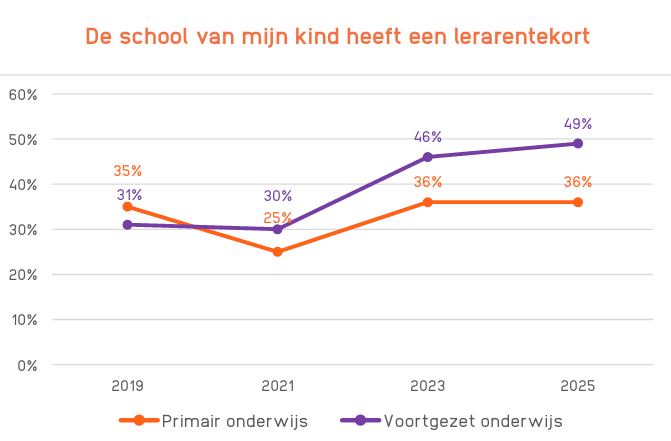
In secondary education, the effects of the teacher shortage are most noticeable. Almost half of parents with a child in secondary school say they suffer from the shortage. But it is a big problem in primary education as well. Here, 36% of parents notice the consequences of the teacher shortage.
Many parents are positive about the relationship with the school
Good cooperation between parents and school helps with good education. The majority of parents (69%) says they have a good relationship with the school. They feel involved and get enough information about what happens at school. Yet a large group of parents stay less positive about cooperation. Many improvements are still needed here.
Many children still have stress from pressure to perform
Many children feel pressure to get good grades and do well at school. This is a bit higher in secondary education, namely 48%. At primary education, the pressure is almost as high. Here, 43% of parents say their child suffers from that pressure.
Earlier research by Ouders & Onderwijs shows that performance pressure can have bad effects such as sadness, less confidence, fear of failure and concentration problems.
Many signals about tailored education
Ouders & Onderwijs gets many signals from parents who have problems finding tailored education for their child. In 2024, the advice point of Ouders & Onderwijs received no less than 4500 help requests from parents about tailored education.
In 2024, Ouders & Onderwijs also did research on student transport. Here again, worrying signals from parents appeared. There are many changes of drivers; students are not picked up or picked up too late and often are on the road too long.
A large group, namely 67% of parents, has filed a complaint about student transport. And 28% even multiple times.
More and more parents support inclusive education. About 45% of parents with a child in primary school and 49% of parents with a child in secondary school think every child should be able to go to the same school nearby.
Schools still ask for ‘mandatory’ parent contribution
Every child should be able to join school trips, outings, excursions or other activities. Also if parents cannot or do not want to pay the voluntary parent contribution. A voluntary parent contribution must really be voluntary. Yet some schools still ask for a ‘mandatory’ parent contribution.
In 2019, 36% of parents with a child in primary school said they still had to pay this. Now it is a smaller group, only 20% of parents say the school asks for a mandatory contribution. Still too many, but a clear improvement.
In secondary education, there is also a ‘mandatory’ parent contribution. In 2019, 48% of parents said they had to pay a contribution to the school. This year, only 27% of parents with a child in secondary school say the same.
In primary and secondary education, parents have trouble paying the parent contribution. These parents also feel pressure from the school to pay it, even though it must be voluntary. 21% of parents have trouble paying it in primary education; in secondary education, 26% have trouble.
Smaller classes needed for better education
The Staat van de Ouder 2025 shows that we must keep investing in education. There must be more smaller classes and enough qualified teachers in the classroom. Also, every child must get the support that is needed, in a fitting and safe environment.
The research report the Staat van de Ouder 2025 tells you more about what parents think of education. For example, what parents think about inclusive education? Do children feel much pressure to perform at school? And how is the relationship between parents and school? This and more you find in the Staat van de Ouder 2025.

Sign up for our bi-weekly newsletter!
Receive the latest news, tips and experiences.