



Staat van de Ouder 2026: three quarters of parents do not know how school deals with ai.
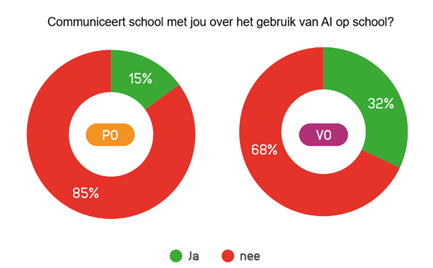
On april 14, the staat van de Ouder 2026 was launched. In this annual study, we asked nearly a thousand parents how they view digitalization in education and AI at school. It appeared that three quarters of the parents do not know how or if AI is used at school.
Ai in the class: widely used, little communication to parents
An unusual result from the study is that more than half of the students in secondary education use AI for schoolwork. For example, to get explanations or to practice for tests. Yet three quarters of the parents do not know how their child’s school deals with this. “Parents are not necessarily for or against the use of AI at school. They do want to know what happens and why school makes certain choices,” says Lobke Vlaming.
Digitalization is daily reality
Ai is not an isolated thing. Parents deal daily with the digital world of their child. Think of social media, group chats and laptops in the class.
Almost all children use social media. Parents see positive sides of it:
- contact with friends
- creative outlet
- developing digital skills
But there are also worries. For example, 27% of the parents say their child sleeps worse because of social media. Other worries parents have are:
- insecurity about appearance
- peer pressure
- negative online experiences
Social media are here to stay
Social media are no longer out of children’s lives. Parents see that their child enjoys it and that it helps to keep in touch with friends. But it also brings worries. For example, a quarter of the parents say their child sleeps worse because of social media. Many parents also worry about the influence on their child’s self-image. You see these worries back in our study. No less than 79% of the parents are in favor of a ban on social media under the age of 16.
Group chats are useful but not always pleasant
For parents, group chats often feel like a digital schoolyard. Useful for practical questions and reminders. Yet parents are not always happy with group chats. Some parents get an “overload” of messages or the conversations are not always about school.
Children’s group chats are also not always seen as fun. A group chat (for example on WhatsApp) can cause peer pressure from classmates or exclusion.
More support for mobile phone ban in the entire school building
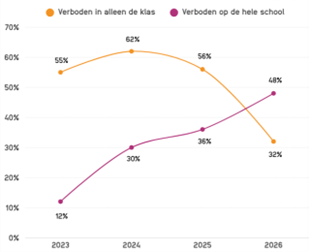
The mobile phone ban at school is gaining more and more support from parents. Almost half (48%) of the parents say their child’s school has introduced a mobile phone ban in the entire school building. Three years ago, this was only 12%. Most parents (70%) support the ban in the entire school building. The support for a ban in the class is even greater, namely 87% of the parents.
Parents see more and more advantages of the mobile phone ban. There is less distraction in the class and more quiet. Children also have more “real” social contact with each other.
Digital learning tools are indispensable but also distracting
At many schools, laptops and other digital learning tools are indispensable. Especially in secondary education, they are often necessary. Parents see advantages like more possibilities to learn and extra support for children who need it.
But there are also worries. Laptops can cause distraction. Children are then more likely to do other things than work on school or do their homework.
Parents also want to be more digital
Children grow up with technology, but parents notice that they themselves sometimes lag behind. Especially in secondary education, many parents feel their child is more digitally skilled than they are.
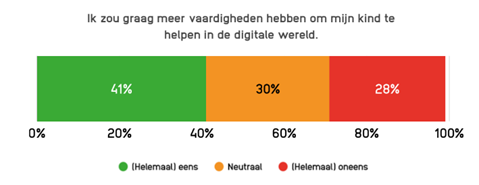
Almost half of the parents therefore want to develop more digital skills themselves. They want to be able to guide their child better in the online world.
Student monitoring systems can be too much
Systems such as Magister or ParnasSys give parents much insight into their child’s school life. Parents can see grades, know what their child’s schedule looks like, and often can also keep track of which homework is planned. Most parents like to see this directly themselves.
At the same time, some parents think children should also have room to tell how things go at school themselves.
Parents want to be involved
What all the themes above have in common is that parents want to be involved in their child’s education. They understand that schools are still searching in this fast-changing digital world.
That is why it is so important for schools to take parents along now in the developments. So not when the policy is finished and the rules are fixed, but precisely in the process before that.
Related Subjects
Joli: ensure clear exceptions for the mobile phone ban
Joli Luijckx, director of Oudervereniging Balans, talks more about the phone ban.
Read morePedro: Bullying does not stop at the door anymore
Pedro De Bruyckere, researcher and educator, talks about digital communication in education.
Read more
Sign up for our bi-weekly newsletter!
Receive the latest news, tips and experiences.