



Review: Staat van de Ouder 2026.
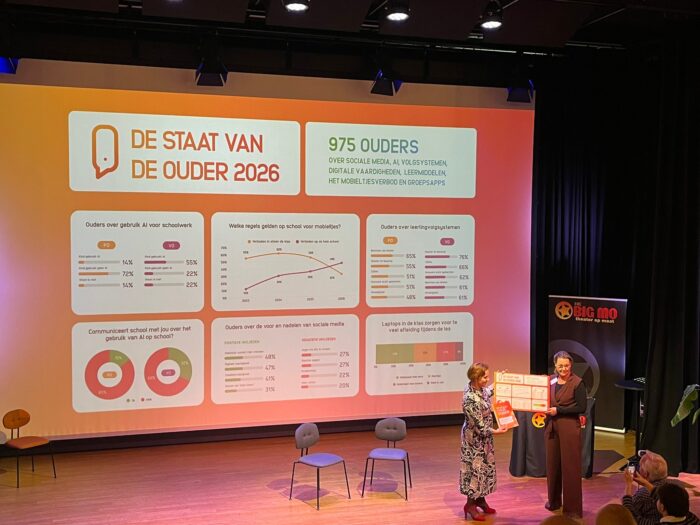
On April 14 we launched our annual research report the Staat van de Ouder. We celebrated this with an afternoon full of theater and interesting conversations. The state secretary also visited to receive the report. The report and the event focused this year on digitalization in education. In this article we take you through the event.
An opening about opportunities and concerns
director of Ouders & Onderwijs, Lobke Vlaming, opened the afternoon with a word of thanks to all parents who participated in the research. Thanks to their input the report gives a good picture of how parents experience dealing with digitalization. Lobke also goes deeper into the advantages and disadvantages of digitalization in education.
Digitalization offers many opportunities. Think of faster contact with school, more insight into your child’s progress and new ways of learning. But it also brings challenges. Parents are for example worried about screen time, distraction in class and online safety.
Recognizable situations on stage
Theater group The Big Mo brought the figures and stories from the report to life with several recognizable scenes.
In the first scene a parent thanked the teacher for listening after his daughter was bullied via Snapchat. A situation that sadly can be familiar and shows again the importance of good contact between school and parents.
Then followed a scene where two fathers stood directly opposed. One enthusiastic about AI, phone use and social media, the other strongly against. By talking to each other they eventually found more understanding and a middle way. A nice illustration of how different parents’ opinions can be on this topic. And especially how important a good conversation and an open attitude is.

Much social media use and little insight
Another moment came during the scene about social media. The report the Staat van de Ouder shows that as many as 97% of children use social media. And only a very small group of parents say they really know what their child does there. When the question was asked to the audience who sometimes looks at their child’s phone, most hands stayed down.
In the scene a child received a jumping video via Snapchat. This is a video where children jump on one other child as a group. A question was asked to the audience: who is responsible? The school or the parents?
The answer from the audience was clear. You can only tackle this together. Good communication from school and open talks at home are indispensable.
Who could have prevented this?
Another intense scene showed how quickly it can go wrong. A girl sends a ‘exciting’ photo to a boy she likes. When a friend of the boy takes the phone away, the photo spreads through the school. The girl does not want to go back to school after the holiday.
The question which party in this story could have prevented this, did not get a clear answer. This also shows that situations like the one portrayed are often not black and white at all.
However, a few clear solutions came forward. File a report, talk to all involved and focus mainly on prevention. Giving information about online behavior and sharing images is also very important.
In conversation with the state secretary
At the end of the afternoon the report was handed over to state secretary Judith Tielen. In a conversation with Lobke she talked about the role of digitalization in education.
During the conversation the main results of the report were also shared with the state secretary and the audience.

Sign up for our bi-weekly newsletter!
Receive the latest news, tips and experiences.