



Stop pressure and coercion in inappropriate education.

Parents of children with support needs regularly face youth protection measures. Parents Association Balans therefore organized the work congress ‘Afraid of pressure and coercion’. Professionals from youth care and education spoke together about using pressure and coercion and the position of children and their parents in it.
A report by Marieke Boon
Background
Conflicts between parents, school, and/or care providers about what a child needs, who has the duty of care, and who pays for extra support occur more often. Mediators (such as education consultants) are needed to calm such conflicts. It often happens that education or care professionals put pressure on parents to accept help through youth protection (Veilig Thuis report and supervision order). This comes from the (sometimes naive) assumption that parents get faster help this way. But youth protection is never meant for this: it is a pressure and coercion framework to ensure the safety of children – with all consequences for families.
Veilig Thuis report causes much harm
The conference started with the story of two parents who impressively shared their experience organizing education for their child. They could not solve things with the school, leading to (several) Veilig Thuis reports. It became clear how big the impact was. Even if an investigation shows no child abuse. ‘A Veilig Thuis report can be made quickly but recovering from it takes the family years,’ one parent said. Such a report is very serious and affects you as a parent. You are seen as a bad parent. This causes much fear and removes all trust in the professional. ‘Give family members aftercare after a false report,’ one parent suggested.
Adjust reporting code
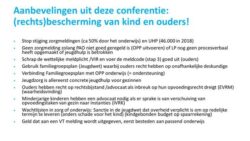
These parents and other speakers were clear about the following advice: ‘Do not push education problems to youth care when it does not work. Stop using Veilig Thuis for education problems. Let parents and school look for solutions together.’ The reporting code Domestic Violence and Child Abuse for education professionals should be adjusted for this.
It was also said that step 3 in the reporting code is often not used well. This step says the professional talks with parents about concerns and the idea of making a Veilig Thuis report. This is different from telling parents that a Veilig Thuis report has been made, which is often the case. The advice is to discuss concerns first and then decide if a report is needed.
How effective is reporting?
Youth policy and youth protection focus on safety: ‘Every child safe’ is the slogan. But what is safety? When do we call something safe and can we keep it safe together? These questions came up several times. Especially around pressure and coercion. How do these relate to the safety of the child? We often do not know the effects of a pressure and coercion process and its impact on the child and family. They can cause harm and create insecurity for parent and child. Especially if the bond between parent and child is hurt. Mariëlle Bruning, professor Youth Law at Leiden University, said parents fear pressure. She thinks this should not be needed with good participation and the willingness to work together.
More important levers to improve lie in talking with parents. We can gain by investing in professionals’ attitude toward parents and their skills to talk and continue talking with parents. Also by paying attention to parents’ emotion regulation (fear and anger) and professionals’ (fear of disciplinary law, consequences of not acting wrongly, angry parents). Fear plays an important role for both and can decide their behavior and actions, causing unwanted effects.
Youth protection may not provide help
The contribution of Adri van Montfoort was inspiring. He has worked in youth care for years and gave a historical overview showing that youth aid may provide less help. Child protection researchers, youth protection case managers, youth care offices, Veilig Thuis and various coordinators in municipal teams may not provide help. ‘What do they then do and who gives help?’ Adri gave clear advice for a simpler system with youth protection, youth aid, and a clearer protective role for the juvenile judge to ensure children’s safety.
Learning from Belgium
The final part of the conference was a dialogue between Jolande uit Beijerse (UHD criminal and criminal procedure law Erasmus School of Law) and Johan Put (Professor Youth and Social Law KU Leuven). They compared the Dutch system and the Flemish youth aid system. It became clear our system offers too little protection for parent and child from coercion. In Flanders, child and parents have a lawyer (who stays with the child until adulthood). Another advice is more speaking time during hearings. Now there are only 5 minutes in a removal case.
Next steps
This important subject is not finished with this conference. It lives strongly among parents. Some parents recently started a petition. The conference succeeded in showing the parent perspective within pressure and coercion and pointing out that lack of Tailored Education, lack of knowledge, or perverse (financial) incentives must not lead to (more) pressure and coercion. Parents Association Balans processes all input into a statement and a small group of attendees will tackle concrete matters. To be continued.
More information is available on the website of Balans.
Marieke Boon is theme advisor Tailored Education at Ouders & Onderwijs. The work conference was organized by Parents Association Balans with cooperation from Interest Group Intensive Child Care BVIKZ, Ieder(in), Program Care for Youth and Ouders & Onderwijs.

Sign up for our bi-weekly newsletter!
Receive the latest news, tips and experiences.