


Test willingness among parents limited.
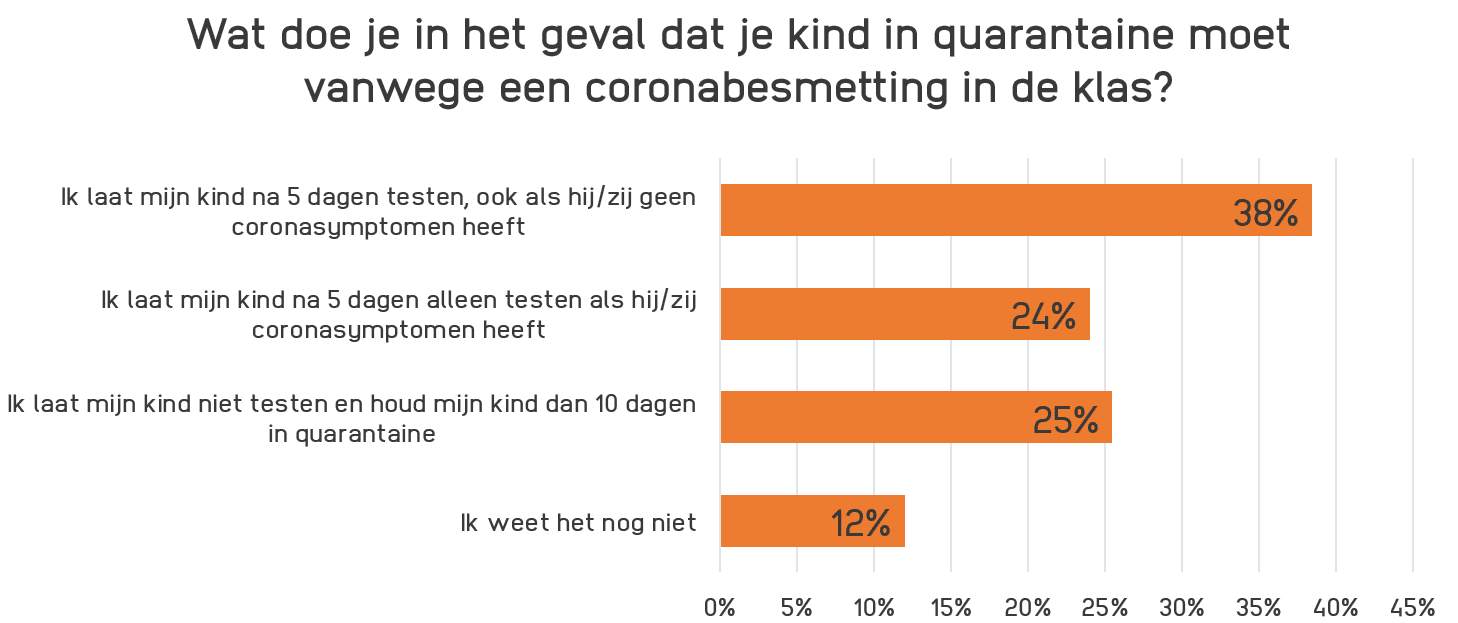
Despite growing concerns about corona infection at school, a quarter of parents are not willing to have their child tested after a positive case in the class. They prefer a quarantine of 10 days. Another 24% want testing only if the child has symptoms. Parental willingness to test is limited. These numbers come from research by Ouders & Onderwijs among parents of school-aged children.
Sixty percent of parents worry that their child might get infected with the coronavirus at school. This number has increased since the summer holidays. It was below forty percent then.
Measures
The majority of parents think the current measures at schools are enough. Most parents with a child in primary education do not think it is necessary to extend the measures. More than half oppose wearing face masks, keeping 1.5 meters between students, and halving class sizes. A slight majority sees benefits in working in fixed groups to limit contacts. Parents are divided over the newest tightening in primary education — keeping a child home with a runny nose — 42% think this is too strict, 45% agree with this tightened measure.
Parents with a child in secondary education are more often in favor of (extra) measures. Almost half think contact between students should be limited by working in fixed groups. They also support halving classes, wearing face masks, and keeping 1.5 meters distance.
Self-test
The first schools have started with self-tests. Research shows that the majority of parents in secondary education are positive about the option for students to voluntarily take a self-test at school: 49% are in favor, 27% are against.
61% Of parents dealt with a child staying home
More than sixty percent of parents had a child at home since the (partial) reopening of schools. In primary education, this was mostly because the child had corona symptoms (30%). In secondary education, most children stayed home due to teacher shortages (34%). Also, a group of parents saw their child go into quarantine: 17% in primary education, 11% in secondary education.
For most children who have to stay home because of corona, education fortunately continues. In primary school, students mainly get homework from school. In secondary education, 62% follow lessons via livestream and 45% get homework through an online student or homework system.
About the corona research
Last year, Ouders & Onderwijs conducted several studies about parents’ views on corona-related topics at school, such as the measures, willingness to test, parents’ satisfaction with information at school, and their children’s wellbeing during this corona period. The research was completed by 1437 parents, via the Landelijk Ouderpanel. The results represent all parents in the Netherlands.
See the complete report of the study. Do you also want to join the discussion about education in the Netherlands? Register now for the Landelijk Ouderpanel or read more about this online panel.
Test willingness among parents limited.
Related Subjects
Parents want smaller classes
Parents want smaller classes on a large scale. Large classes go at the expense of education quality according to parents. In addition, their children go to school with less pleasure and feel less safe in a large class. This is one of the conclusions from the Staat van de Ouder this year based on research among parents.
Read moreAfter-school care reopens
From next Monday 19 April the after-school care (BSO) will open again. The same rules as at schools apply. This means that a whole class or group goes into quarantine in case of infection. Interim prime minister Rutte and minister De Jonge announced this during the press conference.
Read moreConversation guide impact corona
In the National Education Program (NPO), it was agreed that schools map out the effects of corona on their students' education. To involve parents, Ouders & Onderwijs developed a conversation guide together with other organizations.
Read moreMeer informatie

Sign up for our bi-weekly newsletter!
Receive the latest news, tips and experiences.