



Reading ability dropped again: what do the new pisa figures mean for your child?.
Almost four out of ten 15-year-olds in the Netherlands do not read well enough to keep up at school. This is shown by the new PISA figures published today. The figures show a decline again: in 2018 it was a quarter of the students and in 2022 about a third.
Ouders & Onderwijs, before publishing the figures, together with eleven other educational organizations, made a call to the House of Representatives and the state secretary for a joint approach. The publication of the PISA figures shows that this call has become even more urgent.
What is PISA and what was researched?
PISA is an international study of the performance of 15-year-olds in reading, mathematics and science. The study is conducted every three to four years.
In the Netherlands, more than 6,600 students from 177 schools participated.
What do the figures show?
The outcome for reading is strong. The figures show that 39 percent of 15-year-olds in the Netherlands do not reach the minimum level for reading. This level is needed to participate well at school and later in society.
In 2018 it was still a quarter of the students, in the previous study from 2022 about a third. The decline continues.
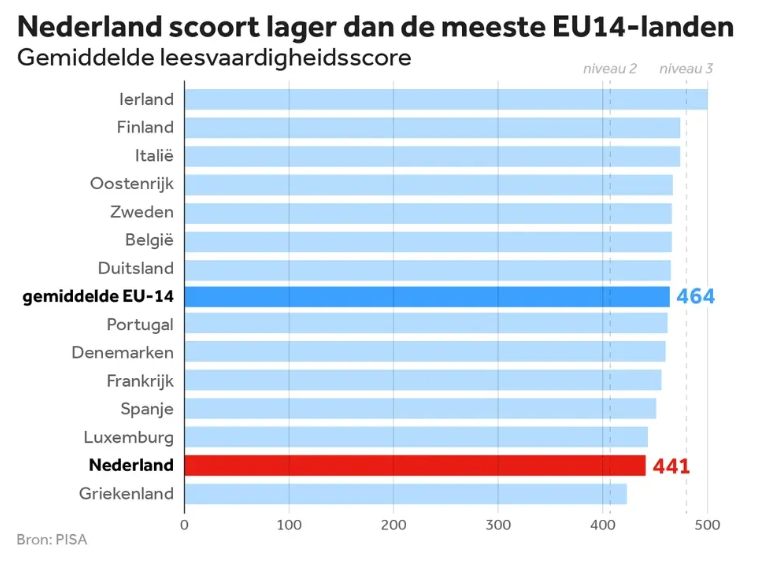
In other countries, reading skills are also declining, but the Netherlands scores clearly lower than comparable EU countries. For mathematics and science, the average score remained the same.
Which students have more difficulty with reading?
The PISA figures show differences between groups of students. Boys generally read less well than girls. The type of school and the education of parents are also related to average reading skills.
Students in pre-university education score on average higher than students in pre-vocational secondary education. Children of parents with a higher professional or university education also read better on average. Equal opportunities and reading skills are closely related.
Why is being able to read well so important?
Being able to read well is needed in many more subjects than just Dutch. If a child has difficulty reading, it can also cause problems in other parts of education.
Think of for example:
- a text or assignment in mathematics;
- a text in social studies;
- an instruction on a test.
Reading also remains important outside of school. Think of a leaflet with a medicine, a letter from the municipality or information you encounter online. The ability to understand and assess information you encounter remains important all your life.
Response from the state secretary
State secretary Judith Tielen (Education and Emancipation) calls the decline a long-term problem but says that the Netherlands cannot afford “any further decline.”
According to the state secretary, being able to read well is needed in all subjects at school and later at work. She refers to the new core objectives, introduced this school year as a first step.
What does Ouders & Onderwijs ask of politics?
On September 7, 2026, Ouders & Onderwijs together with eleven other educational organizations (including the PO Council, VO Council, AOb, CNV Education, AVS, MBO Council, Foundation For Working Parents and LAKS) sent a letter to the House of Representatives and the state secretary.
The organizations ask for a joint approach to the declining reading skills.
The letter contains five important points.
- Implement the new core objectives well.
Reading and language must get attention in every subject. Not only in subjects with tests. - Invest in teachers and school leaders
Teachers and school leaders need good training and support to teach children to read better. - Reduce differences between schools
Right now it matters a lot which school a child goes to. Those differences need to get smaller. - Make schools and parents cooperate better
Schools and parents can contribute together to improving children’s language skills. - Provide structural funding
Declining reading skills require a long-term approach. Money for one or two years will not solve the problem.
In addition, we ask the government to pay better attention to the influence of large tech companies on young children and to gain more control over the learning resources schools use.
Related Subjects
Reading aloud: cozy and a nice rest moment
Before your child learns to read by themselves, it is important to read aloud regularly. This is good for your child's language development. Do you ever read to your child? How often do you do this? And why?
Read moreLessons and subjects
Ouders & Onderwijs is er voor alle ouders met kinderen in de schoolgaande leeftijd. Ouders kunnen bij ons terecht voor advies en antwoorden op hun vragen.
Read moreProblems with the delivery of school books again
Again problems with the delivery of schoolbooks
Read more
Sign up for our bi-weekly newsletter!
Receive the latest news, tips and experiences.